
Echinacea
Folk names: Purple coneflower, Black Sampson, Rudbeckia, ConeFlower
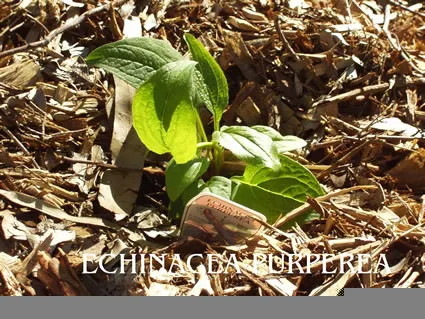
| Family | Compositae/Asteraceae |
|---|---|
| Genus | Echinachea |
| Species | purpurea |
| Part(s) used | Root and rhizomes, arieal parts. |
Antibacterial, Antimicrobial, alterative, tonic, antiviral, vulnerary. (what these mean)
Uses
Stimulates the immune system, and is used for colds and flu's. Can be used to rid the body of boils, septicemia and other infections. When combined with couchgrass, yarrow, buchu and Uva Ursi it can be used for cystitis and Uti's. For laryngitis, tonsillitis, pharyngitis and infections of the upper respiratory system it can be used alone or with Baical Skullcap, thyme, Astragalus, Garlic, sage, cleavers, poke root, Echinacin has been shown to inhibit the formation of hyaluronidase by bacteria thus localising the infection and halting the spread of it. In Ayurveda it is said to reduce Pitta and Kapha and stimulate Vatta NB. contains a Quercetin a compound which is a MAO - A inhibitor therefore should not be used by anyone taking SSRI's or antidepressants.
Majikal uses
It is used as an offering to spirit by North American tribal peoples to strengthen spells.
Constituents
Quercetin, volatile oil, glycosides, echinaceine, phenolics. Caffeic acid congugate - cichoricacid, echinacoside, 6-caffeoyl echincoside, cynarine, verbascoside, chlorogenic and rosemarinc acids. Unsaturated isobutyl amides including echanacin, undeca, dodeca, trideca, pentadeca~dien-diyonic acid isobutylamides. Polysaccharides- heerooxlans and arabinorhamnogalactans. Essential oil containing humulene, caryophyliene and its epoxide- germacreneD, and methyl-p-hydroycinnamate. Also vanillin, linolenic acid derivatives, rutin and a lbdane derivative.