
Calendula
Folk names: Bride of the Sun, Drunkard, Golden Holigolde, Husband - mans dial, Marybud, Marygold, Mary Gowles, Ruddes, Ruddles, Sposa Solis, Summer's Bride
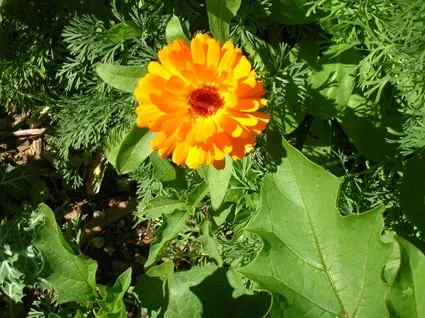
| Family | Compositae/ Asteraceae |
|---|---|
| Genus | Calendula |
| Species | officinalis |
| Part(s) used | the flowers |
Antiphlogistic; Anti-inflammatory, Anti -haemorrhagic, Anti fungal, Antiseptic; Antispasmodic; Aperient; Astringent; Cholagogue; Diaphoretic; Emmenagogue; Stimulant; Styptic, Vulnerary. (what these mean)
Uses
Calendula flowers can be eaten fresh in salads for the carotenoids. They are made into an infusion and used in creams, lotions and ointments for eczema, dermatitis or psoriasis as a vulnerary or antimicrobial. It is very useful in an ointment or a lotion for burns, wounds, bruising, bleeding, nappy rash, sore nipples, scalds. Internally as a tea it can be used for stomach disorders, gastric and duodenal ulcers. It also can be used internally and externally for fungal infections. The polysaccharides have been shown to be immunomodulators and soothe irritated mucosal membrane.
Majikal uses
Calendula are used for protection, to assist with dreams , for getting justice in court, to aid psychic powers and for prophetic dreams. Hang on the door posts of the home they will prevent negative energy from entering.
Constituents
Saponins, carotenoids, bitter principles, essential oils, sterol, flavonoids, mucilage, triterpenes, pentacyclic alcohols - faradol, brein, arnidiol, erythrodiol, calenduladiol, heliantriols A1, B0, B1, B2, ursatriol, longispinogenine, calendulosides A-D, calendaspononins A, B, C, D. alpha and beta amyrin, taraxasterol and lupeol, isorhamnetin glycosides including nanarcissin, quercetin glycodides including rutin. Sesquiterpene and ionone glycosides, officinosides A, B, C, D. Loliolide, arvoside A. Chlorogenic acid, Polysaccharides.